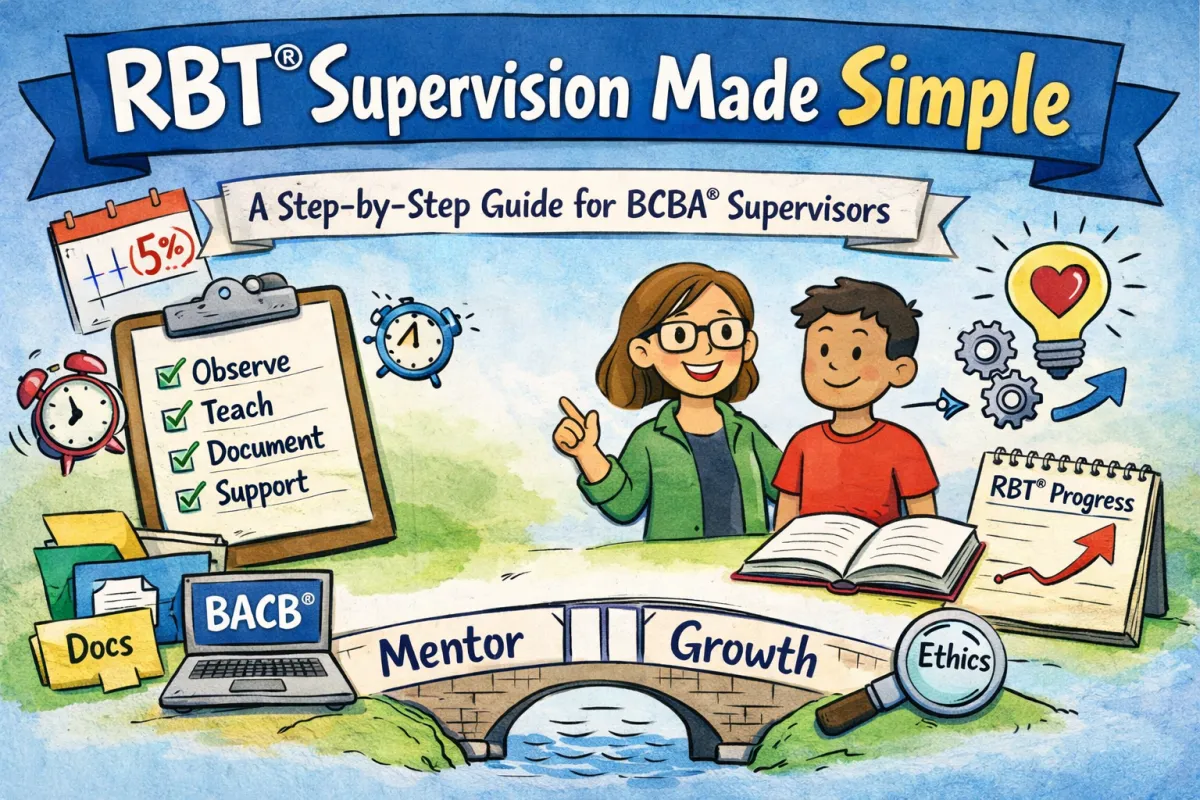
RBT® Supervision Made Simple: A Step-by-Step Guide for BCBA® Supervisors (With Tools You'll Actually Use)
You just hired (or inherited) your first RBT®. You’re excited to get started—but also a little panicked.
You’ve read the BACB® handbook. You’ve skimmed a few CEUs. But somehow, it still feels like you’re being handed a puzzle without the picture on the box.
How much time should I spend supervising?
What should I actually do during sessions?
How do I keep track of everything without risking noncompliance?
If that sounds familiar, you’re not alone. RBT® supervision can feel overwhelming—especially when you’re trying to juggle clients, paperwork, and ethical obligations.
But with the right tools and a simple structure, you can turn supervision into something far more powerful than a checkbox. You can transform it into a mentorship model that builds confident, competent, and values-driven RBTs®.
Let’s walk through how.
RBT® Supervision Made Simple: A Step-by-Step Guide for BCBA® Supervisors (With Tools You'll Actually Use)
1. Know Your Role: You’re Not Just a Supervisor, You’re a Mentor
2. Set the Foundation: Before Supervision Starts
Supervision Start-Up Checklist
3. Build the Structure: What Supervision Actually Looks Like
4. Plan for Progress: Monthly & Quarterly Goals
5. Keep It Legal: Documentation & Compliance
6. Lead with Purpose: Align Supervision to Your Values
Final Thoughts: You Don’t Need to Know Everything—Just the Next Step
1. Know Your Role: You’re Not Just a Supervisor, You’re a Mentor
Supervision is more than meeting a 5% requirement. It’s your opportunity to model clinical reasoning, ethical judgment, and compassionate care.
Think of your role as:
A trainer — teaching practical ABA skills
A coach — building confidence and resilience
A guide — modeling professional and ethical behavior
Think of yourself as a compass for your RBT®—helping them navigate unfamiliar terrain with clarity and direction.

2. Set the Foundation: Before Supervision Starts
Before you even begin delivering supervision, get these essentials in place:
Supervision Start-Up Checklist
Confirm RBT® certification status via the BACB® Registry
Create and sign a supervision contract
Determine your supervision schedule (minimum 5% of RBT® hours)
Select a documentation method (Google Drive, platforms like Catalyst or Motivity)
Clarify communication expectations and feedback frequency
According to the Behavior Analyst Certification Board® (BACB®, 2022), RBT® supervision must meet specific percentage, documentation, and ethical requirements.
Need a ready-to-use system for all of this?
Grab the FREE Elevate RBT® Supervision Tracker to organize hours, assessments, and documentation—all in one place.
3. Build the Structure: What Supervision Actually Looks Like
Supervision should include a balance of the following formats:
A. Direct Observation
Observe sessions in real time (or via video)
Provide immediate feedback
Model and role-play when needed
B. Individual Meetings
Review session data
Discuss ethical dilemmas
Set training goals
C. Skill-Building Activities
Use BST (Behavior Skills Training)
Role-play key task list items
Review and practice documentation skills
Supervision Formats

Want to skip the guesswork on training topics?
The ASCEND RBT® Assessment System includes built-in, task list-aligned topics and assessment tools so you can track progress and set individualized goals without reinventing the wheel.
4. Plan for Progress: Monthly & Quarterly Goals
Use supervision time not just for oversight but for growth. Here's how:
Track supervised hours using the 5% rule
Conduct performance check-ins monthly
Use a structured rubric or your own fidelity rating scale
Set quarterly skill goals aligned with the RBT® Task List
Ongoing feedback and structured goal-setting are foundational strategies in high-quality supervision. Evidence-based training approaches, like Behavior Skills Training (BST), help RBTs® retain skills and maintain treatment fidelity over time (Parsons et al., 2012).
ASCEND makes this easy: Use its training topics to guide supervision and track progress. It even integrates with CEUs aligned with each topic: Explore CEUs here
5. Keep It Legal: Documentation & Compliance
BACB® supervision standards require you to document every interaction. That includes:
Format (direct vs indirect)
Duration and date
Topics covered
Signatures from both parties
Store records securely and keep them for 7 years. Consider using:
Google Forms or Drive (manual)
ASCEND (automated)
Motivity, Catalyst, CR Essentials (paid options)
Download the FREE Elevate Supervision Tracker to make this part easy and audit-proof.
6. Lead with Purpose: Align Supervision to Your Values
Supervision is a values-based practice, not just a task. Discuss values, empathy, and ethics openly.
Ask RBTs® about their goals
Discuss cultural responsiveness and client dignity
Bring in real-life ethical scenarios
Want CEUs that go deeper into meaningful supervision?
Check out supervision-aligned CEUs like:
Ethics in the Rearview: Turning Blind Spots into Supervision Strategies
Decision Ready RBTs®: Supervision Strategies that Build Autonomy and Protect Your Time
When Plans Meet Real Life: Building Clinical Thinking and Situational Awareness in Your Team
7. When It’s Time to Level Up
Encourage your RBTs® to reflect, grow, and move forward:
Conduct self-assessments using ASCEND
Invite peer reviews or skill demonstrations
Support those interested in BCBA®-track pathways
The best supervisors don’t just create competent RBTs®. They create confident future leaders.
Final Thoughts: You Don’t Need to Know Everything—Just the Next Step
RBT® supervision doesn’t have to feel overwhelming.
With the right tools and a simple roadmap, you can:
Stay compliant
Support RBTs® with clarity
Build a supervision system you can scale and be proud of
Start now with this free tool:
Download the Elevate RBT® Supervision Tracker
Recommended Reading for BCBA® Supervisors
These open-access and widely cited resources can help deepen your understanding of effective, ethical, and purpose-driven RBT® supervision.
Behavior Analyst Certification Board®. (2022).
Ethics code for behavior analysts. https://www.bacb.com/ethics-code/
Behavior Analyst Certification Board®. (2022).
RBT® supervision requirements. https://www.bacb.com/rbt/rbt-requirements/
LeBlanc, L. A., Sellers, T. P., & Valentino, A. L. (2020).
Building and sustaining meaningful and effective relationships as a supervisor and mentor. Oakland, CA: New Harbinger Publications.
Parsons, M. B., Rollyson, J. H., & Reid, D. H. (2012).
Evidence-based staff training: A guide for practitioners. Behavior Analysis in Practice, 5(2), 2–11. https://doi.org/10.1007/BF03391819
Sellers, T. P., Valentino, A. L., & LeBlanc, L. A. (2016).
Recommendations for detecting and addressing barriers to successful supervision. Behavior Analysis in Practice, 9(4), 309–319. https://doi.org/10.1007/s40617-016-0142-z
This post is brought to you by Elevate Your ABA Supervision — empowering BCBA® supervisors to simplify, strengthen, and scale their supervision systems.
