The One-Word Check-In: Bringing Mind-Body Awareness into Live ABA Supervision
Ask most BCBAs what they track during in-vivo supervision and you'll get a precise list: procedural fidelity, prompting hierarchy adherence, data collection accuracy, reinforcement delivery timing. Ask the same BCBAs how their RBT was feeling during that same session, and you'll usually get a shrug. We've built an entire clinical model around measuring behavior, and yet the internal state of the person delivering that behavior — the RBT who's been running discrete trials for six hours, managing a challenging behavior plan, and holding a client's frustration alongside their own — rarely gets measured at all.
That gap matters. RBT burnout, compassion fatigue, and turnover are some of the most persistent problems in our field, and they don't show up as a dramatic event. They show up as a slow drift: fidelity slipping, enthusiasm flattening, a good clinician quietly checking out weeks before they hand in notice. If we only find out during a quarterly review or an exit interview, we've found out too late to do anything useful with it.
Why the obvious fix doesn't fit
The wellness-coaching world has an answer for this: brief mind-body check-ins, borrowed from motivational interviewing, where a coach pauses before a goal-setting conversation and asks someone to notice how they're doing in their body before asking them to change anything. It's a genuinely good technique. It's also built for a completely different environment than the one our RBTs are working in.
An RBT running a session isn't sitting across from someone with room to pause and reflect. They're knee-deep in trials — managing a behavior plan in real time, keeping data, keeping a client regulated — and there's no point in that flow where a BCBA can open with "let's pause and notice how you're feeling in your body" without derailing the session. The client loses momentum. The RBT loses their place. So the technique gets tried once, doesn't fit, and quietly gets shelved as "nice in theory."
The problem was never the check-in itself. It's that we tried to import the pause along with it, and ABA sessions don't have a spare pause sitting around waiting to be used. So the real question isn't how to make room for one. It's whether the room already exists and we've just never looked at it as a check-in opportunity.
Use the breaks that already exist
It does exist — several times over, in nearly every session. Reinforcement intervals. Transitions between programs. The few seconds a client spends independently engaged with preferred materials. None of these moments were designed as a check-in window, but a BCBA conducting live supervision is already watching for exactly these breaks, because that's when fidelity notes get jotted and data gets glanced at anyway.
Nothing new has to be added to the session for this to work. The pause we thought we needed to create was already built into the structure — it just never had a job. Given one, it only needs to hold one word.
Instead of a full check-in, the supervisor simply asks: "One word — how are you right now?" during one of these existing breaks. No follow-up conversation, no disruption to the session, no signal to the client that anything unusual is happening. Just a single data point, gathered in real time, from the person who's actually in the room doing the work.
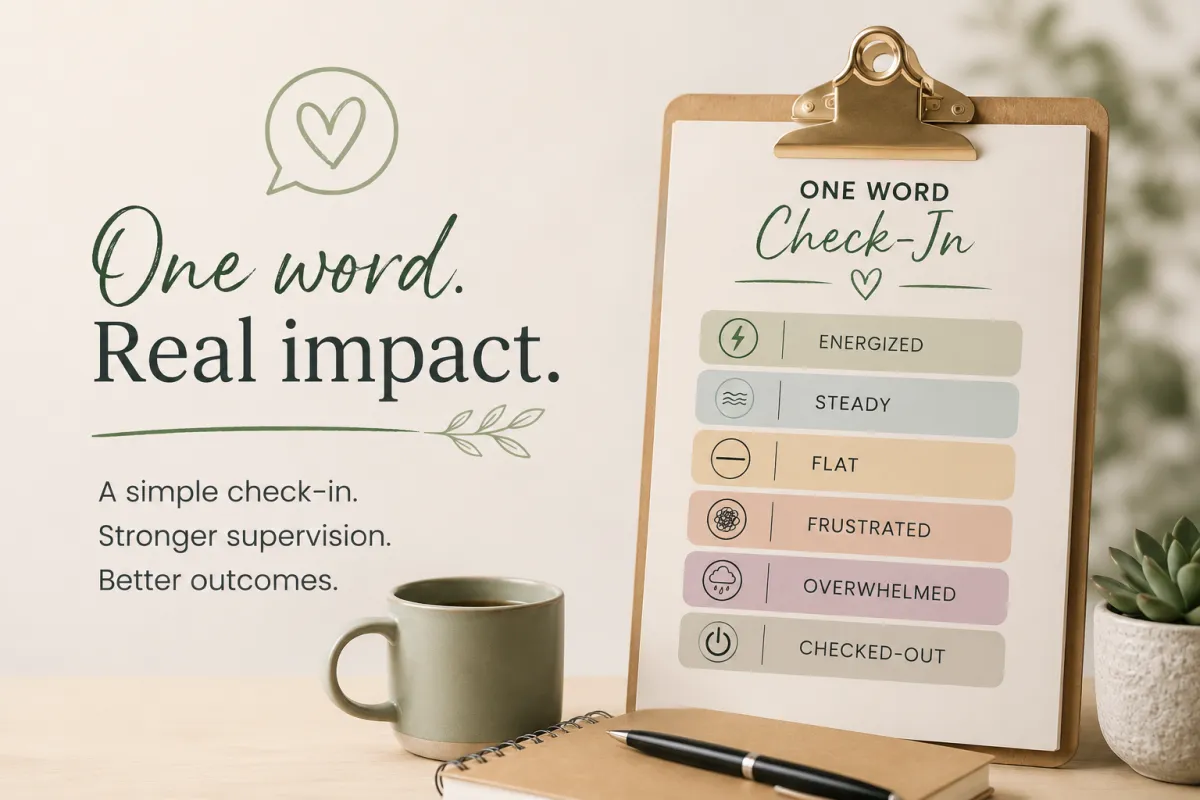
To keep it fast and consistent across supervisors, it helps to offer a short word bank rather than an open prompt — something like:
Energized · Steady · Flat · Frustrated · Overwhelmed · Checked-out
Six options, memorized by every supervisor and RBT on a team, callable in the time it takes to glance at a clipboard.
Why this is worth doing the ABA way
Here's the part that makes this feel less like a soft add-on and more like something that belongs in our field: we already believe that what gets measured gets managed. That's the entire premise of ABA. So instead of treating RBT wellbeing as a vague, anecdotal concern that only surfaces in a crisis, log the one-word response as a field on the supervision fidelity checklist, right alongside the other data points from that observation.
Over time, that single word becomes a trend line. A string of "flat" or "overwhelmed" ratings on a particular caseload, a particular time of day, or a particular client, is a signal worth investigating before it becomes a fidelity problem or a resignation letter. And because it's already logged data rather than a memory someone has to surface in a review meeting six weeks later, it's something you can actually act on — the same way you'd act on any other trend in the data.
This isn't about replacing supervision conversations with a checkbox. The regular supervision meeting, away from the client, is still where the real coaching happens — where a BCBA can use motivational-interviewing-style reflection instead of pure corrective feedback, and where a pattern of "overwhelmed" ratings becomes a real conversation about caseload, support, or burnout risk. The one-word check-in doesn't replace that work. It's what makes sure that work has something real to respond to, instead of waiting for a crisis to make the problem visible.
Try it this week
Pick a five- or six-word bank with your team. Attach the check-in to a break that already exists in your sessions — don't invent a new one. Add it as a single field on your existing fidelity checklist. Then look at the trend, not the individual data point, the next time you sit down for supervision.
It's a two-second addition. It treats the wellbeing of the person delivering treatment with the same rigor we've always given the behavior of the person receiving it. And it might be the earliest warning system your supervision model has been missing.
Give it a place to live
A one-word check-in only works as data if it actually gets written down somewhere alongside the rest of your session notes. The ASCEND RBT Supervision Tracker is built for exactly that — a spot to log this check-in every session, right next to the data you're already collecting, so the trend is visible instead of anecdotal. Grab it free → HERE.
And if you'd rather see this in action than read about it, I walk through it on video here.
Research referenced:
Integrating mind-body processes and motivational interviewing in health coaching — https://pmc.ncbi.nlm.nih.gov/articles/PMC12087188/
