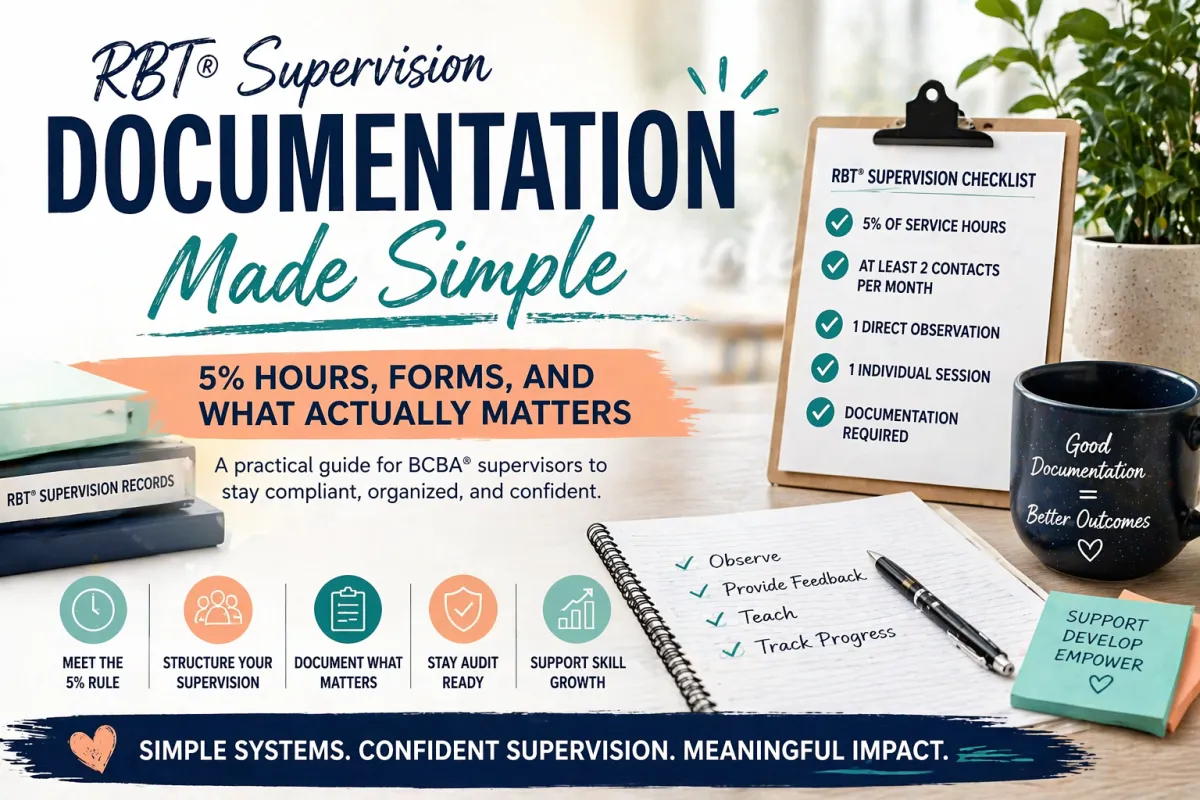
RBT® Supervision Documentation Made Simple: 5% Hours, Forms, and What Actually Matters
You open your spreadsheet.
Or your Google Doc.
Or your notebook.
Or… three different systems you think you’re supposed to be using.
You’re trying to make sure your RBT® supervision is documented correctly, but questions keep popping up:
Do I track every hour or just supervision hours?
Do I need monthly verification forms?
What actually needs to be documented?
What happens if I get audited?
And maybe the biggest one:
Why does this feel so much more complicated than it should be?
If that sounds familiar, you’re not alone.
RBT® supervision documentation is one of the most confusing—and most stressful—parts of supervision for BCBA®s.
But it doesn’t have to be.
Let’s simplify it.
RBT® Supervision Documentation Made Simple: 5% Hours, Forms, and What Actually Matters
Why Supervision Documentation Feels So Overwhelming
What the BACB® Requires (Current 2026 Standards)
What This Means for Supervisors
Important Clarification (Most People Get This Wrong)
What You Actually Need to Track
Required Structure of Supervision (Often Missed)
What You Actually Need to Document
Additional Documentation Requirements
The 7-Year Rule (Don’t Skip This)
Do You Need Monthly Verification Forms?
Why Many Supervisors Still Use Monthly Forms
Audits: What Supervisors Need to Know
How to Simplify Your Supervision System
4. Align Documentation With Training
5. Use Structured Systems (When You’re Ready)
Free Resource: Simplify Your Supervision Tracking
Questions to Ask Yourself as a Supervisor
Final Thoughts: Documentation Should Support You—Not Stress You
Why Supervision Documentation Feels So Overwhelming
Most BCBA®s were never explicitly trained in how to document supervision.
Instead, you probably learned by:
copying systems from coworkers
piecing together BACB® requirements
hoping your system would hold up in an audit
The result?
➡️ Overcomplicated trackers
➡️ Inconsistent documentation
➡️ That low-level “I hope this is right…” feeling
But here’s the truth:
Documentation doesn’t have to be complicated to be compliant.
What the BACB® Requires (Current 2026 Standards)
Let’s ground this in what’s currently required.
According to the most recent RBT® Handbook, supervision must include:
At least 5% of hours spent providing behavior-analytic services each month
At least 2 supervision contacts per month
At least 1 direct observation of service delivery
Ongoing documentation of supervision activities
What This Means for Supervisors
As of 2026, RBT® certification now includes:
A 2-year recertification cycle
Required professional development hours
So supervision isn’t just about meeting monthly requirements anymore.
It’s also about:
building long-term competence
supporting ongoing skill development
preparing RBTs® for recertification
Important Clarification (Most People Get This Wrong)
The 5% requirement is based on:
Hours spent providing behavior-analytic services—not all paid hours
That means:
✔ Direct therapy time counts
✔ Service-related activities may count
❌ Admin time, driving, and unrelated tasks typically do not
The 5% Rule (Made Simple)
Let’s take the stress out of this.
If an RBT® provides:
100 hours of ABA services → 5 hours of supervision required
80 hours → 4 hours required
40 hours → 2 hours required
What You Actually Need to Track
You only need to consistently track two core numbers:
Hours spent providing ABA services
Supervision hours delivered
Everything else builds from there.
Required Structure of Supervision (Often Missed)
This is where many supervisors unintentionally fall out of compliance.
Supervision must include:
✔ At least 2 contacts per month
✔ At least 1 direct observation
✔ At least 1 individual supervision session
✔ Optional: small group supervision (2–10 RBTs®)
This structure matters just as much as the 5% requirement.
What You Actually Need to Document
Let’s strip documentation down to what truly matters.
For each supervision interaction, document:
Date
Duration
Type (direct vs. indirect)
Format (individual or group)
Activities (observation, feedback, training, etc.)
Supervisor name
Whether a direct observation occurred
Additional Documentation Requirements
To stay fully aligned with BACB® expectations, your system should also include:
Total service delivery hours
Names of supervisors involved
Evidence of supervisor–client relationship (if needed)
Supporting documentation (session notes, data, etc.)
The 7-Year Rule (Don’t Skip This)
This is one of the most important—and most overlooked—requirements:
Supervision documentation must be retained for at least 7 years
Even if:
the RBT® leaves
the supervisor changes
you change companies
This is critical for audit protection.
Do You Need Monthly Verification Forms?
Short answer:
➡️ No specific form is required by the BACB®
BUT…
You do need documentation that clearly shows:
supervision occurred
requirements were met
activities were appropriate
Why Many Supervisors Still Use Monthly Forms
Because they:
✔ simplify organization
✔ reduce missed requirements
✔ make audits easier
The form itself isn’t required—clarity is.
Audits: What Supervisors Need to Know
Here’s the part most people don’t talk about enough:
The BACB® can audit supervision records at any time.
If documentation is missing or incomplete, consequences may include:
loss of certification
ineligibility for recertification
disciplinary action
That’s not meant to scare you—it’s meant to emphasize this:
A simple, consistent system protects you.
How to Simplify Your Supervision System
Let’s make this practical.
1. Use One System (Not Three)
Pick one place to track everything:
hours
supervision
notes
Multiple systems = missing data.
2. Track in Real Time
Avoid:
“I’ll update this later.”
Because later becomes:
“I hope this is accurate…”
3. Use Templates
Templates reduce:
decision fatigue
inconsistency
missing information
4. Align Documentation With Training
Instead of writing:
“Observed session. Provided feedback.”
Try documenting:
skill targeted
feedback given
next steps
This turns documentation into a clinical tool, not just a requirement.
5. Use Structured Systems (When You’re Ready)
Many supervisors struggle with:
“What should I focus on in supervision?”
Using structured systems can help connect:
supervision
training topics
skill development
Tools like the ASCEND RBT® Assessment System allow supervisors to:
assess RBT® skills
guide supervision conversations
track growth over time
So documentation becomes part of the learning process, not separate from it.
Free Resource: Simplify Your Supervision Tracking
If you want a simple, organized way to track everything:
Download the Free Elevate RBT® Supervision Tracker to:
track 5% supervision hours
document supervision sessions
organize training topics
stay audit-ready
👉 https://elevateyourabasupervision.com/elevate-subscribe
Questions to Ask Yourself as a Supervisor
Instead of asking:
“Am I doing this perfectly?”
Ask:
Can I clearly show supervision occurred?
Can I demonstrate what was taught?
Can I verify I met requirements?
Would this make sense in an audit?
If yes—you’re on the right track.
Final Thoughts: Documentation Should Support You—Not Stress You
Supervision documentation isn’t about perfection.
It’s about:
clarity
consistency
accountability
When your system is simple and intentional, documentation becomes something that:
supports your work
strengthens your supervision
protects your practice
And most importantly—
It gives you more time to focus on what actually matters:
👉 Supporting your RBTs® and improving client outcomes
References
Behavior Analyst Certification Board®. (2025).
Registered Behavior Technician Handbook.
https://www.bacb.com/rbt-handbook
Sellers, T. P., Valentino, A. L., & LeBlanc, L. A. (2016).
Recommendations for detecting and addressing barriers to successful supervision. Behavior Analysis in Practice, 9(4), 309–319.
